Disclaimer: The views and opinions expressed in this article are solely those of the author and do not necessarily reflect the official policy or position of WERC.
When ChatGPT first hit the scene, many of us saw it as our smart assistant. AI was something you could ask questions and get instant answers from. But over time, a new kind of AI has emerged. One that doesn’t just respond to chats, it takes action.
That action is called an AI agent.
As someone who has built automation solutions for companies in relocation and beyond, I’ll admit, even I was confused when I first heard about AI agents. I thought, “Is this just another buzzword for putting AI into an automated workflow?” But once I saw how these tools could work like actual team members, I realized this is what global mobility teams have been needing.
Whether this is the first time you’ve heard of AI agents or trying to come up with ideas on where they could be used, this article will spark ideas. I’ll walk you through what AI agents are, how they differ from the tools you’re already familiar with, and how they can solve the biggest challenges relocation professionals face today.
The 3 Levels of AI Explained
Let’s simplify what’s happening with AI right now. There are three levels we see in the workplace:
Level 1: Chatting – AI responds to humans with zero memory between interactions.
Level 2: Automation with AI steps – AI responds to input from the previous automation step; no agency.
Level 3: Automation with agents – AI has instructions, input, and tools to take actions independently.
| Level |
Description |
Limitations |
|
Level 1: Chatbots
|
These are tools like ChatGPT. You ask, “What’s our mobility policy on housing stipends?” and it gives you an answer—if you feed it the right info.
|
Manual, copy-paste, no systemization
|
|
Level 2: Automation + AI Steps
|
Think of automations in tools like Zapier. For example, when a transferee is added to a system, it auto-sends a welcome email. Helpful, but it only works if the path is clear and predictable.
|
No adaptability or self-direction. Now almost always replaced with AI agents.
|
|
Level 3: Automation + AI Agents
|
This is where things really shift. AI agents don’t wait for one clear step; they reason through goals, move across systems, and take actions like a human teammate.
|
Still needs structure, testing, and human oversight
|
What Exactly Is an AI Agent?
So, what is an AI agent, really? If you’re picturing another chatbot or digital assistant that just spits out answers to your prompts, think again. An AI agent is more like a dependable digital team member, one that doesn’t take lunch breaks or need PTO.
It doesn’t just wait for you to ask a question; it is waiting 24/7 for it to be triggered. You give it a goal, and it figures out how to get there by reasoning through the steps, interacting with your systems, and taking real action.
An AI agent can track visa timelines, monitor housing assignments, summarize lengthy policy documents, and even send real-time alerts to the right people, all without a human manually kicking off those tasks. It behaves the way a well-trained coordinator would, with the added bonus of operating 24/7, across systems, and at scale.
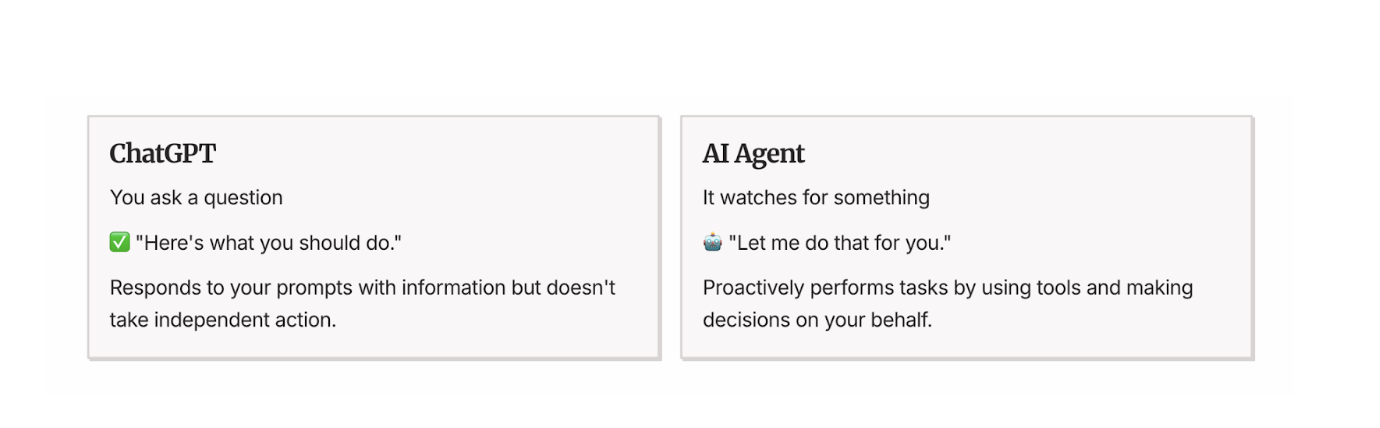
The Difference Between Chat Prompts and AI Agents
AI agents act like a really smart assistant who doesn’t just answer your questions but actually takes action for you.
How AI Agents Lighten the Load in Global Mobility
These are just a few of the AI agents I’ve seen work well in mobility:
Lease Expiration
An agent notices a lease is about to expire → checks if the transferee has a new housing assignment → sends a reminder to the assignee → notifies the vendor.
And it does all of this without anyone needing to prompt it.
Document Retrieval
Prompt: “What’s the mobility policy for [name]?”
→ The AI agent finds the correct document in your shared drive and opens it.
Want a specific item in the policy? Ask it a question and it pulls out the relevant section and answers you.
Timeline Tracking
Agents can monitor visa expirations, lease end dates, and insurance renewals, and send nudges to HR, vendors, or assignees before deadlines hit.
Policy Help Desk
One of the biggest challenges in supporting transferees is time zone differences. AI agents can be your “always-on mobility coordinator,” providing immediate guidance and information, no matter where or when questions arise. Agents can provide 24/7 answers to:
- “Can I bring my dog?”
- “What’s my housing budget?”
- “How long do I get in temp housing?”
You can also ask questions in other languages and the agent will respond in that language.
Try in “Can I bring my dog?” in Portuguese, “Posso levar meu cachorro?”
For companies managing multiple transferees across different regions, this support dramatically reduces response delays and keeps relocation experiences smooth and stress-free.
See an AI agent in action answering transferee policy questions. This demo AI agent watches for questions about the policy, accesses the policy, and answers the transferee’s questions in seconds.
Why AI Agents Are the ‘Simplifier’ for Mobility Teams
Often, I am a part of conversations around the global mobility industry needing and wanting a simpler way to manage the transferee process. Not only are there hundreds of moving parts to a relocation, but you are also dealing with speed, accuracy, and personalization. In many relocation management companies (RMCs), global mobility managers and destination service providers are juggling increasingly complex processes with limited resources and lean teams. That’s where I see the potential for AI agents.
They don’t replace the human touch that makes relocation services feel personalized and empathetic; instead, they amplify it.
By taking over repetitive tasks, tracking timelines, pulling documents, and sending reminders, AI agents give your team back the time they need to focus on what really matters: guiding people through life-changing transitions.
AI agents also reduce the risk of burnout by removing the constant mental load of managing every detail manually. That kind of reliability and relief is something every relocation leader can benefit from.
Getting Started: What You Need to Know
If you’re wondering whether your team is ready for AI agents, here’s the truth: The AI itself isn’t the biggest hurdle; your internal structure is. Before you can successfully implement an AI agent, you need to create the right environment for it.
Think of it like onboarding a new hire. You wouldn’t throw a new employee into a messy file system with no naming conventions, scattered documents, and unclear processes and expect them to get it right.
Before launching agents, prep these areas:
- Centralized systems: Agents need specific places to access information. For instance, you shouldn’t have documents saved in Sharefile, Dropbox, and your personal document folder on your computer. There needs to be one place for the agent to access.
- Defined workflows: Map out what you want the agent to handle.
- Permissions: Make sure the agent can access what it needs.
- Feedback loop: Treat it like a new hire and train, test, improve.
Finally, remember that AI agents still require human oversight. They’re powerful, but they’re not infallible. Your team’s judgment, creativity, and strategic vision are what make these tools effective, not the other way around. Start small, iterate often, and keep your people in the loop every step of the way.
If you are interested in seeing other ways AI can be used in global mobility, check out this article.